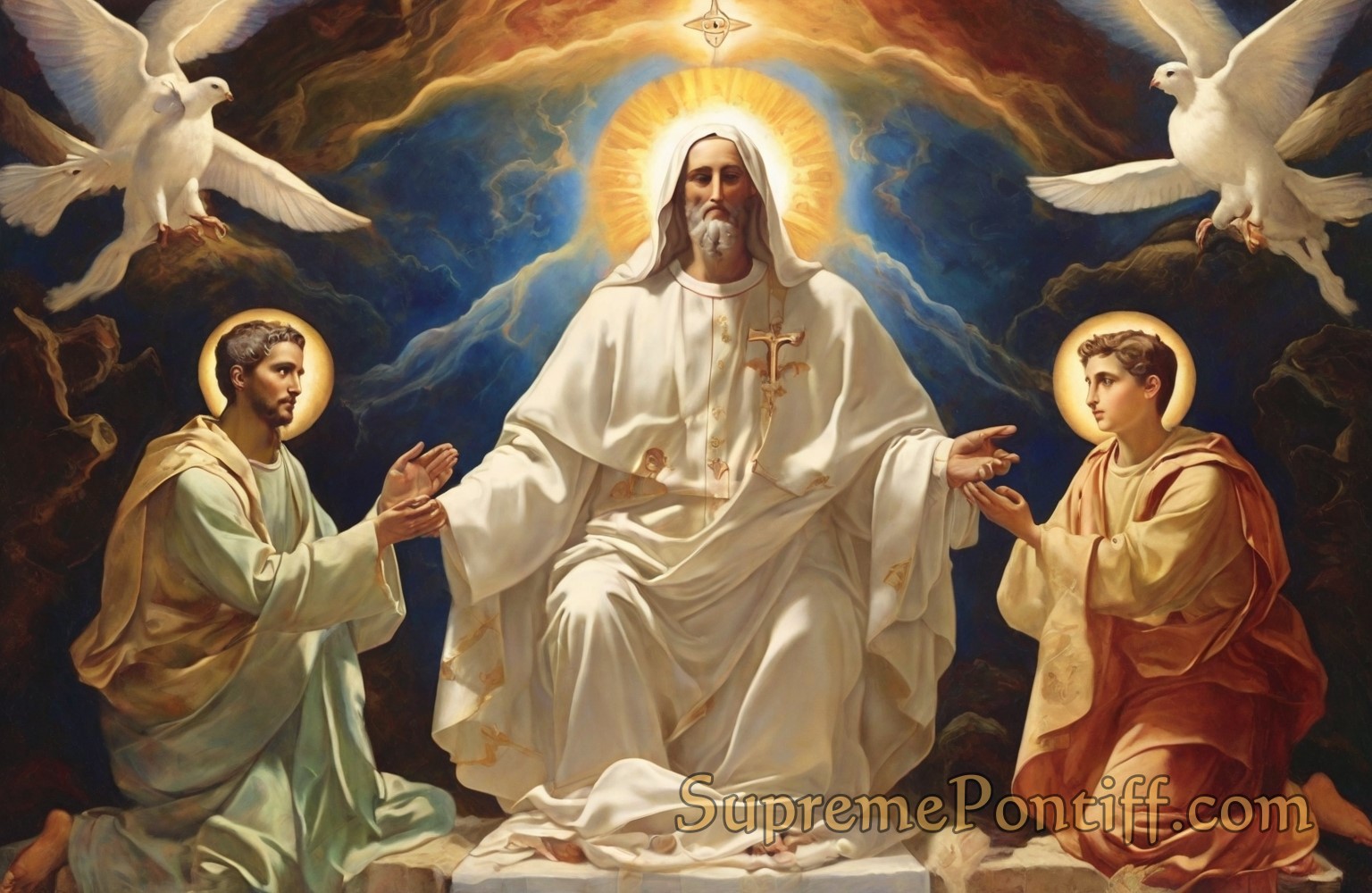
The doctrine of the Holy Trinity is one of the central and most complex tenets of Christian theology. It posits the existence of one God in three distinct persons: the Father, the Son (Jesus Christ), and the Holy Spirit. Although the term “Trinity” itself does not appear in the Bible, the concept is derived from a synthesis of scriptural teachings and has been a focal point of theological development and debate since Christianity’s earliest days.
Historical Development and Theological Foundations
The formulation of the Trinity emerged over several centuries as the early Christian community sought to reconcile monotheism with the divinity of Jesus and the presence of the Holy Spirit.
- Scriptural Basis: The foundations of the Trinity are rooted in the New Testament. Key scriptural references include the Great Commission in Matthew 28:19, where Jesus commands his apostles to baptize “in the name of the Father and of the Son and of the Holy Spirit,” and the Pauline benediction in 2 Corinthians 13:14. The Gospel of John extensively discusses the unity and distinctions between the Father and the Son, particularly in passages like John 1:1-14 and John 10:30.
- Early Church Councils: Significant clarification of the Trinity emerged from the ecumenical councils of the early church, which addressed Christological and theological controversies. The First Council of Nicaea (325 AD) was pivotal in asserting the consubstantiality (homoousios) of the Son with the Father, producing the Nicene Creed as a statement of faith. The First Council of Constantinople (381 AD) further elaborated on the Holy Spirit’s role and divinity, solidifying the orthodox understanding of the Trinity.
- Church Fathers: Prominent theologians such as Athanasius, the Cappadocian Fathers (Basil the Great, Gregory of Nyssa, and Gregory of Nazianzus), and Augustine of Hippo were instrumental in articulating the doctrine. Augustine’s work “De Trinitate” remains one of the most influential texts exploring the nature of the Triune God.
Theological Aspects
The doctrine of the Trinity encompasses several key theological aspects:
- Unity and Distinction: The Trinity maintains that there is only one God, a belief at the heart of Christian monotheism. However, God exists eternally in three persons, each person being fully and equally God, distinct yet not divided. The Father is not the Son, the Son is not the Holy Spirit, and the Holy Spirit is not the Father.
- Economic and Immanent Trinity: Theologians differentiate between the immanent Trinity (God’s inner life and relationships within the Godhead) and the economic Trinity (how God interacts with the world). The economic Trinity is often seen in the roles attributed to each person: the Father as creator, the Son as redeemer, and the Holy Spirit as sanctifier.
- Perichoresis: This concept, often translated as “mutual indwelling,” describes the interpenetration and indwelling of the three persons of the Trinity. It signifies a profound and eternal communion, where each person continually shares in the life and work of the others, maintaining unity without blending.
Symbolism and Representation
Throughout Christian history, various symbols have attempted to represent the mystery of the Trinity. The triquetra, a three-pointed knot, emphasizes the interconnectedness yet distinctness of the Trinity. Another popular symbol is the shamrock, famously used by St. Patrick to explain the Trinity as three leaves on a single stem, illustrating unity and multiplicity.
Ecclesiastical and Devotional Implications
The doctrine of the Holy Trinity has profound implications for Christian worship, spirituality, and ecclesiology. The Trinitarian formula is central to Christian liturgy, especially in sacraments such as Baptism and the Eucharist. It also shapes Christian prayer, epitomized in the doxology: “Glory be to the Father, and to the Son, and to the Holy Spirit.”
In terms of ecclesiology, the Trinity provides a model for unity and diversity within the Church. The relational nature of the Trinity serves as an example for community life, emphasizing love, mutual respect, and cooperation.
Challenges and Criticisms
Despite its central status, the doctrine of the Trinity has faced challenges and remains a subject of debate and misunderstanding. Some question its biblical basis, given the absence of the explicit term “Trinity.” Others find the concept paradoxical or difficult to comprehend, occasionally leading to heretical views such as Modalism, which denies the distinctiveness of the three persons, and Arianism, which denies the full divinity of the Son.
Conclusion
The doctrine of the Holy Trinity is a cornerstone of Christian faith, encapsulating the mystery of one God in three persons. It is a profound theological statement about God’s nature and action in the world, profoundly influencing Christian doctrine, worship, and community. As both a theological and a mystical concept, the Holy Trinity invites continual reflection, exploration, and devotion within the Christian tradition.

Leave a Reply