
For centuries, the Catholic Church has observed a time-honored and carefully regulated system to elect a new Pope, a procedure steeped in rich tradition and governed by specific rules. When people ask, “Who Will Be the Next Pope?”, they are often curious about how someone becomes the leader of over one billion Catholics worldwide. The question of who would be the next Pope becomes even more relevant now, after the announcement of Pope Francis’ death. Although no one can predict precisely who will succeed the late Pope Francis, the process that unfolds upon his death is well-defined. Here is a comprehensive look at everything you need to know about the papal succession.
1. The Period of Sede Vacante (Vacant See)
“Sede Vacante” is a Latin phrase that literally means “the seat being vacant.” It begins immediately following the death of a Pope or his resignation. During this time:
- The Papal See is considered officially unoccupied.
- The College of Cardinals, under the guidance of the Cardinal Camerlengo, assumes the responsibility of administering the Church’s day-to-day affairs.
- No significant decisions or new appointments are made until a new Pope is elected.
2. The Role of the College of Cardinals
The College of Cardinals, as established centuries ago, holds the primary responsibility for electing the next Pope. Key points include:
- Eligibility of Cardinals: Generally, only cardinals who have not yet reached the age of 80 on the day the vacancy occurs are entitled to vote in the conclave.
- International Representation: Cardinals come from diverse geographical backgrounds, reflecting the universal nature of the Church.
- Preliminary Meetings: Before the conclave, the cardinals convene in General Congregations to discuss various administrative matters and to set the date for the start of the conclave.
3. Preparations for the Conclave
A conclave traditionally begins between 15 to 20 days after the Pope’s death or resignation. This waiting period is intended to:
- Allow time for all eligible cardinal-electors worldwide to travel to Vatican City.
- Provide a mourning period for the deceased Pope (if he has died).
- Ensure that all administrative details are in place so the election can proceed without interruption.
4. Entering the Sistine Chapel
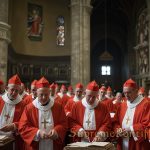
The actual process to elect the next Pope takes place in the historical Sistine Chapel within Vatican City. The term “conclave” means “with a key,” pointing to the confidentiality and isolation required of the electors:
- Secrecy and Isolation: Once the cardinals enter, they are locked in until a new Pope is chosen. Communication with the outside world is strictly forbidden.
- Oaths of Secrecy: All cardinal-electors take a solemn oath not to reveal what transpires during the voting process.
5. The Voting Process
The procedures for the conclave and papal election are based on canonical law and established instructions, notably the Apostolic Constitution “Universi Dominici Gregis” issued by Pope John Paul II. The voting follows a formal structure:
- Multiple Ballots: Each day typically includes four ballots — two in the morning and two in the afternoon — until a cardinal receives a two-thirds majority of the votes. Only then is the candidate considered validly elected.
- Tallying Votes: After each round, votes are counted, and the papers are burned in a special stove.
- Black Smoke and White Smoke: When ballots do not result in an election, black smoke (fumata nera) is released to indicate no decision. Once a cardinal meets the required majority, white smoke (fumata bianca) signals a new Pope has been chosen.
6. Acceptance and the Papal Name
When a cardinal receives the necessary votes and is declared Pope-elect, he is asked if he accepts. If he does accept:
- Name Selection: The new Pope chooses a papal name — often honoring a saint or a predecessor whose legacy he hopes to emulate.
- The Announcement: A senior cardinal steps onto the balcony of St. Peter’s Basilica and proclaims “Habemus Papam!” (“We have a Pope!”), introducing the new Pontiff by his chosen name.
7. Factors Influencing “Who Will Be the Next Pope”
While the identity of the next Pope cannot be foreseen, several factors typically influence the voting process:
- Pastoral Experience and Leadership Qualities: Cardinals often look for a candidate who has shown strong pastoral leadership and administrative abilities.
- Geographic and Cultural Balance: Electors may consider the global composition of the Church when choosing a Pope to reflect broader representation.
- Theological Stance and Vision: A candidate’s approach to Church teachings, social justice, and dialogue with the modern world can play a significant role.
8. Modern Realities and Ongoing Changes
In recent times, the Catholic Church has addressed unprecedented situations — such as Pope Benedict XVI’s resignation in 2013 — leading to a timely conclave that elected Pope Francis. Today, factors like global outreach, interfaith dialogue, and evolving pastoral needs continue to shape what cardinals might look for in the next Pope. Additionally:
- Health Concerns: Modern popes carry significant engagements that may influence their ability to continue their pontificate, raising awareness of potential resignations or earlier transitions.
- Youthful and Diverse Cardinals: Pope Francis has elevated many new cardinals from the Global South, potentially influencing the election’s outcome with a broader cultural perspective.
9. Predicting the Next Pope: Papabili and Speculation
Even among well-informed Vatican watchers, guesses as to “Who will be the next Pope?” remain just that — speculative. Although media may highlight certain cardinals seen as “papabili” (Italian for “pope-able”), the final decision is a product of deep discernment, prayer, and the collective judgment of the cardinal-electors. Throughout history, numerous elections have yielded unexpected results, making predictions notoriously unreliable.
Conclusion
Answering the question “Who will be the next Pope?” illuminates a centuries-old tradition that is both deeply spiritual and steeped in complex canonical regulations. The modern conclave, while involving an international group of cardinals with wide-ranging perspectives, remains firmly rooted in tradition. From the somber period known as Sede Vacante to the dramatic moment white smoke billows from the Sistine Chapel, this process is designed to uphold continuity, unity, and the doctrinal integrity of the Catholic Church.
While no individual can definitively name the next Pope (some top contenders are listed HERE), understanding how a conclave works offers a glimpse into the careful discernment and age-old ceremonies that shape the spiritual leadership of millions of Catholics around the globe.


Leave a Reply