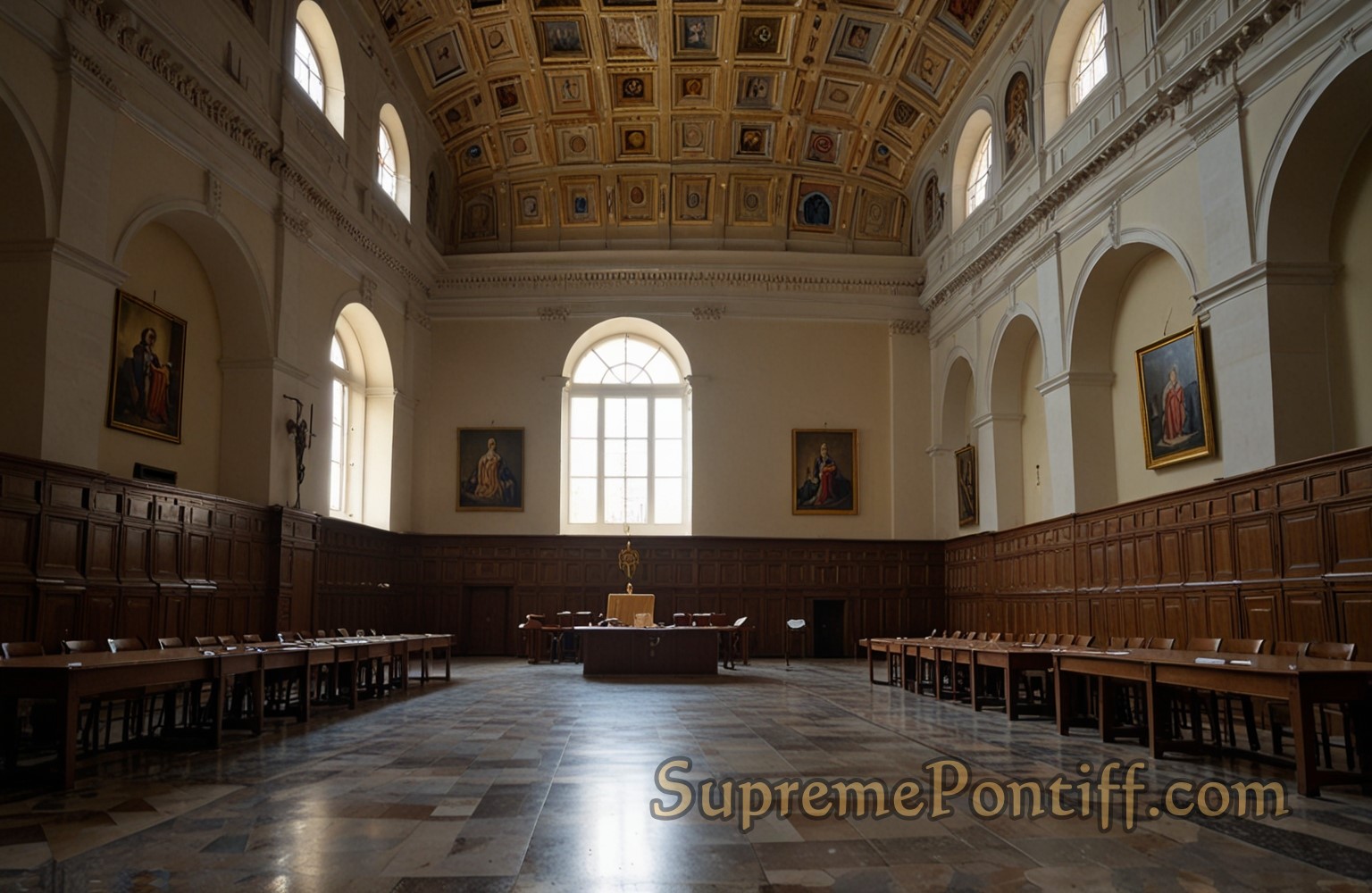
The Secretariat of State of the Holy See stands as the oldest and one of the most pivotal dicasteries within the Roman Curia, the central papal governing bureaucracy of the Catholic Church. Deeply rooted in centuries of tradition and sanctified in its mission to serve Christ through service to the Pope and the universal Church, the Secretariat of State exemplifies the Holy See’s commitment to promoting Christian values in international affairs, ensuring proper governance of the global Catholic community, and safeguarding the spiritual welfare of the faithful.
1. Historical Foundations and Evolution
A. Early Origins
- The genesis of the Secretariat of State can be traced back many centuries, arising from the papal chancery and other related offices that supported the Bishop of Rome in administrative duties.
- Over time, this foundational body evolved to meet the Church’s growing need for organized governance and consistent foreign relations.
- By establishing clear frameworks of communication, the Secretariat laid the groundwork for the modern-day approach to international dialogue and cooperation that upholds Christian ideals of harmony, justice, and peace.
B. Formal Development
- Several popes and Church councils refined and codified the Secretariat’s responsibilities, ensuring that it systematically navigated the Church’s expansion and challenges.
- In the 16th and 17th centuries, successive pontificates consolidated various clerical offices into one cohesive structure, culminating in the officially recognized “Secretariat of State.”
- During the course of the 20th century, key reforms — such as those enacted under Pope Paul VI (Regimini Ecclesiae Universae) and Pope John Paul II (Pastor Bonus) — further clarified the Secretariat of State’s organizational framework. Most recently, under Pope Francis (Praedicate Evangelium), the Roman Curia underwent renewed adjustments to enhance the Church’s evangelizing mission.
2. Overall Structure and Responsibilities
A. Cardinal Secretary of State
- At the helm of the Secretariat of State is the Cardinal Secretary of State, traditionally considered the Pope’s closest collaborator and chief adviser.
- The Cardinal Secretary coordinates the office’s various sections and oversees relations with other dicasteries of the Roman Curia, ensuring that all activities remain firmly grounded in Christian doctrine and attentive to the Holy Father’s guidance.
- The current Cardinal Secretary of State (as of May 2025), His Eminence Pietro Parolin, has played a crucial role in shaping the Church’s diplomatic and administrative initiatives, continuing the Secretariat’s longstanding commitment to advancing the message of Christ in the modern world.
B. Sections of the Secretariat of State
- Section for General Affairs (First Section):
- Handles the Church’s day-to-day administrative tasks, manages papal correspondence, and oversees the publication of official documents such as encyclicals and apostolic letters.
- Coordinates the Pope’s schedule, arranges audiences, and ensures that the Holy See’s internal affairs are administered with diligence and fidelity to Catholic teaching.
- Section for Relations with States (Second Section):
- Manages the Holy See’s diplomatic affairs, including establishing and maintaining relations with other nations.
- Negotiates treaties, concordats, and other formal agreements on the Church’s behalf, consistently promoting moral values rooted in the Gospel.
- Works closely with papal legates, nuncios, and ambassadors, reflecting the Holy See’s global scope and moral authority as it seeks to foster peace, protect religious freedom, and uphold the dignity of every human person.
- Section for Diplomatic Staff (Third Section):
- Also known as the Section for the Diplomatic Staff of the Holy See, it focuses on the well-being, formation, and service of the Holy See’s diplomatic personnel worldwide.
- Facilitates the deployment, training, and support of nuncios and other apostolic representatives, ensuring they carry out their duties in harmony with the Church’s teachings.
3. The Secretariat’s Role in the Modern World
A. Coordination of Global Catholic Missions
- The Roman Curia, led in large part by the Secretariat of State, coordinates the Church’s missionary efforts worldwide, extending Christ’s message of hope and salvation to every corner of the globe.
- Through this coordination, the Secretariat fosters unity and cooperation among local Churches, supporting them in their pastoral ministries and social services.
B. Promotion of Peace, Justice, and Christian Morality
- In a rapidly changing world with increasing geopolitical complexities, the Secretariat of State remains committed to promoting peace, advocating for the poor, and defending fundamental human rights.
- Through its diplomatic engagements, it extends the Church’s call for international solidarity, compassion for refugees and migrants, and ethical stewardship of creation.
- As the Holy See’s representative on the global stage, the Secretariat strives to bring Christ’s teachings on love, mercy, and human dignity to the forefront of international policy discussions.
C. Evolution in Pastoral Outreach
- Recognizing the needs of modern believers, the Secretariat of State continually seeks new ways to proclaim the Gospel in public life and media.
- It works closely with other departments and commissions, upholding and spreading the faith in a manner that remains faithful to Scripture and tradition while engaging with contemporary society.
4. Significance for the Universal Church
A. Spiritual and Administrative Pillar
- As the oldest dicastery in the Roman Curia, the Secretariat of State serves as a cornerstone of Church governance, vital to the day-to-day running of ecclesiastical affairs and the spiritual growth of Catholics worldwide.
- Its historical legacy underscores the ancient and living tradition that the Pope, as the successor of Saint Peter, is not only a spiritual shepherd but also a steward appointed to uphold truth, justice, and unity among God’s people.
B. Supporting Papal Authority and Unity
- The Secretariat of State effectively translates the Holy Father’s pastoral vision into action, preserving and strengthening the communion among bishops, clergy, religious, and laity throughout the universal Church.
- Through its oversight, the Secretariat sets the stage for the Church’s ministries — both sacramental and social —to flourish, reflecting the enduring love of Christ in the world.
C. Continued Relevance in the 21st Century
- In an era marked by unprecedented technological advancements, cultural shifts, and humanitarian crises, the Secretariat of State ensures the Holy See remains both a beacon of spiritual solace and an influential moral authority.
- Its tireless efforts to maintain dialogue and unity among nations, religions, and peoples serve as a powerful testament to the Church’s calling to be the salt of the earth and the light of the world (cf. Matthew 5:13-16).
Conclusion
The Secretariat of State of the Holy See stands as a vibrant testament to the Catholic Church’s enduring dedication to shepherding souls, championing Christian values, and forging a more humanitarian global order. Grounded in devotion to Jesus Christ and guided by the Holy Spirit, this oldest dicastery in the Roman Curia epitomizes the Church’s unbroken commitment to unity, charity, and fidelity to the Gospel. Through its prudent governance and far-reaching diplomacy, it continues to serve the universal Church and humanity at large, testifying to the timeless relevance of the Catholic faith and pointing all people to the hope and salvation found in Christ.

Leave a Reply