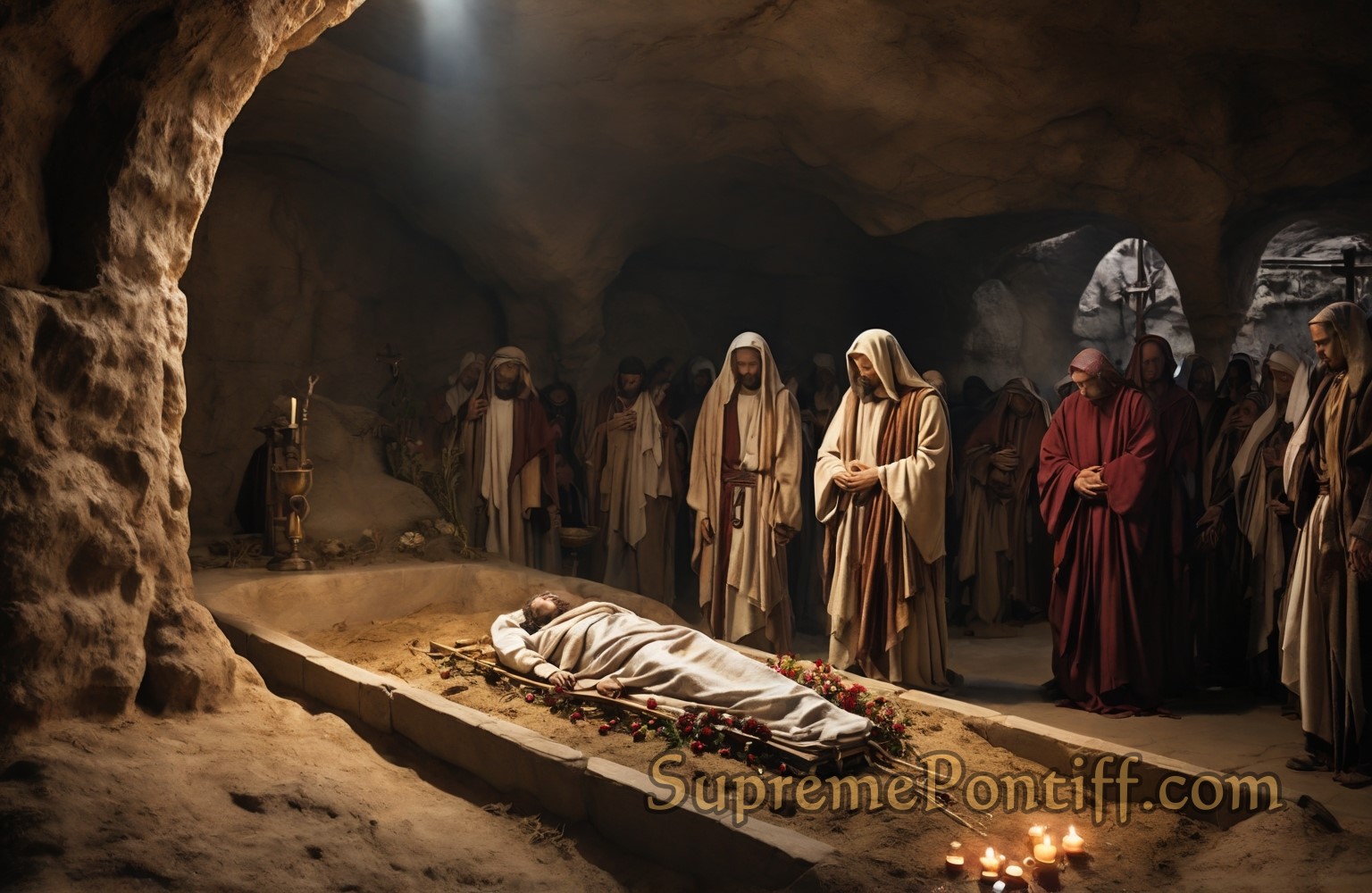
The Burial of Jesus Christ stands as a pivotal event in Christian faith, bridging the sorrow of the Crucifixion with the glorious hope of the Resurrection. This moment, as recorded in the Bible and cherished through centuries of Christian tradition, underscores the authenticity of Jesus’ death, the fulfillment of prophecy, and the promise of new life for believers. This article highlights the deep spiritual meaning of Jesus’ burial, examines the biblical account, explores its historical context, and delves into the lasting implications it holds for Christians around the world.
1. Biblical Account of Jesus’ Burial
The Gospels of Matthew, Mark, Luke, and John all provide accounts of the Burial of Jesus Christ, emphasizing certain aspects of the event from four distinct perspectives, creating a complete and harmonious view when taken together.
Joseph of Arimathea:
According to the Gospel of Matthew, “there came a rich man from Arimathea, named Joseph, who also was a disciple of Jesus” (Matthew 27:57). Joseph of Arimathea courageously went to Pontius Pilate to request the body of Jesus for a proper burial. Although Joseph was a member of the Jewish council, his actions showed faith and reverence towards Christ during a tense and dangerous period.
Nicodemus:
The Gospel of John describes how Nicodemus, the Pharisee who once visited Jesus by night (John 3:1–21), helped Joseph of Arimathea in preparing Jesus’ body. John 19:39 states, “Nicodemus also, who earlier had come to Jesus by night, came bringing a mixture of myrrh and aloes, about seventy-five pounds in weight.” This act signified a reverential treatment often afforded to honored individuals and pointed to their unwavering devotion to the Lord.
The Tomb and Its Significance:
Scripture emphasizes that Jesus was laid in a new tomb, never used before: “Joseph took the body and wrapped it in a clean linen shroud and laid it in his own new tomb, which he had cut in the rock” (Matthew 27:59–60). The tomb’s newness highlights that no other remains lay there, ensuring the resurrection of Jesus could not be mistaken for a confusion with another body.
The Witnesses:
Women who had followed Jesus watched as His body was placed in the tomb: “Mary Magdalene and the other Mary were there, sitting opposite the tomb” (Matthew 27:61). Their presence was crucial, for they would later testify to the empty tomb on Resurrection Sunday, affirming the truth of Christ’s conquest over death.
2. Historical Context of Jesus’ Burial
Roman Crucifixion and Jewish Custom:
Under Roman occupation, crucifixion was a common form of execution. However, executed individuals were often left on the cross or placed in mass graves. In this light, Joseph of Arimathea’s request to bury Jesus in a proper tomb reflected a merciful exception, aligning with Jewish burial customs that demanded prompt interment, especially before the Sabbath (Deuteronomy 21:23).
Pilate’s Role:
Only a ranking Roman official such as Pontius Pilate could grant permission to remove the body of a crucified individual. Pilate’s willingness could have stemmed from Joseph’s status and from his own recognition of Jesus’ innocence (Matthew 27:24). This officially sanctioned burial supports the credibility of the Gospel accounts and the historical reality of Jesus’ death.
The Location of the Tomb:
Early Christian tradition locates the burial site in Jerusalem at what is now the Church of the Holy Sepulchre. This revered location has been the focus of pilgrimages for centuries, symbolizing the very heart of Christian faith. Some Protestant traditions identify the Garden Tomb as an alternative site, yet all Christians agree on the fundamental truth of the burial and resurrection of Jesus Christ.
3. Christian Tradition Surrounding Jesus’ Burial
Liturgical Commemoration:
Holy Saturday in the Christian liturgical calendar commemorates the Burial of Jesus Christ, resting between the sorrow of Good Friday and the joy of Easter Sunday. During this solemn day, believers remember Jesus resting in the tomb, reflecting on the magnitude of His sacrifice.
Iconography and Art:
Christian art throughout the ages has depicted the Burial of Jesus in countless icons, paintings, and sculptures, often emphasizing the reverent pose of Joseph and Nicodemus preparing the body. Churches worldwide may also depict the burial scene in Stations of the Cross, offering worshipers a visual journey with Christ to the tomb.
Significance of the Stone and Sealing:
The Gospels record how a great stone sealed the entrance to the tomb (Matthew 27:60). This physical barrier accentuated the magnitude of the Resurrection that followed, as only the power of God could move the stone and reveal Jesus’ victory over death (Matthew 28:2).
4. The Theological Meaning and Relevance
Fulfilling Scripture:
The Burial of Jesus Christ fulfilled Old Testament prophecies such as Isaiah 53:9: “And they made His grave with the wicked and with a rich man in His death.” By being buried in a rich man’s tomb, Jesus perfectly aligned with the Messianic expectations foretold by the prophets.
Affirmation of the Resurrection:
Jesus’ burial served as a tangible and verifiable event that confirmed His actual death. When the tomb was found empty on the third day, believers were left with the inescapable conclusion that He rose again, just as He had promised. Thus, Jesus’ burial becomes a bridge of faith between the Crucifixion and His Resurrection.
Symbol of Hope and Victory:
The burial also symbolizes hope for all Christians. Just as Christ was laid in the tomb and rose to new life, believers share in the promise that death is not the end. The Apostle Paul articulates this truth in Romans 6:4 when he says, “We were buried therefore with Him by baptism into death, in order that, just as Christ was raised from the dead by the glory of the Father, we too might walk in newness of life.” This newness of life is the heart of Christian joy and victory.
Pastoral Encouragement:
Reflecting on Jesus’ burial offers profound pastoral comfort. In moments of sorrow or affliction, believers can look to the time Jesus spent in the tomb — silent and hidden — yet poised for miraculous resurrection. This pattern of moving from darkness to light encourages Christians to trust in God, even in the darkest nights.
5. Modern Reflections and Archaeological Considerations
The Church of the Holy Sepulchre and the Garden Tomb:
Both the Church of the Holy Sepulchre and the Garden Tomb are venerated by pilgrims who seek to connect physically with the site of Jesus’ burial. Archaeological studies of these locations point to the credibility of early Christian tradition in placing the burial in Jerusalem. While scholars debate which location is authentic, such discussions only testify to the strong historical basis of Jesus’ burial that first-century disciples believed, proclaimed, and died for.
Lessons for Contemporary Faith:
In a world seeking hope, the Burial of Jesus Christ provides a profound reminder of God’s steadfast love and power. It shows that even when situations appear bleak and final, God’s plan overcomes darkness. The encouragement for modern Christians is to trust wholeheartedly in Christ’s victory, living in the assurance that Jesus’ burial and resurrection are cornerstones of Christianity’s eternal hope.
Conclusion
Deeply woven into the tapestry of Christian history and worship, the Burial of Jesus Christ remains a moment of solemn reverence and triumphant expectation. The biblical account and enduring traditions testify that Jesus was truly laid in the tomb, fulfilling prophecy and paving the way for the most significant event in human history: the Resurrection. Rooted in Scripture and alive in the hearts of believers today, the Burial of Jesus Christ gives comfort, assurance, and purpose to all who place their hope in the Risen Lord. As Christians reflect on the Lord’s resting place each Holy Saturday — and indeed throughout the year — they find renewed faith in the promise that death does not have the final word, but that, through Christ, life and victory abound.




Leave a Reply