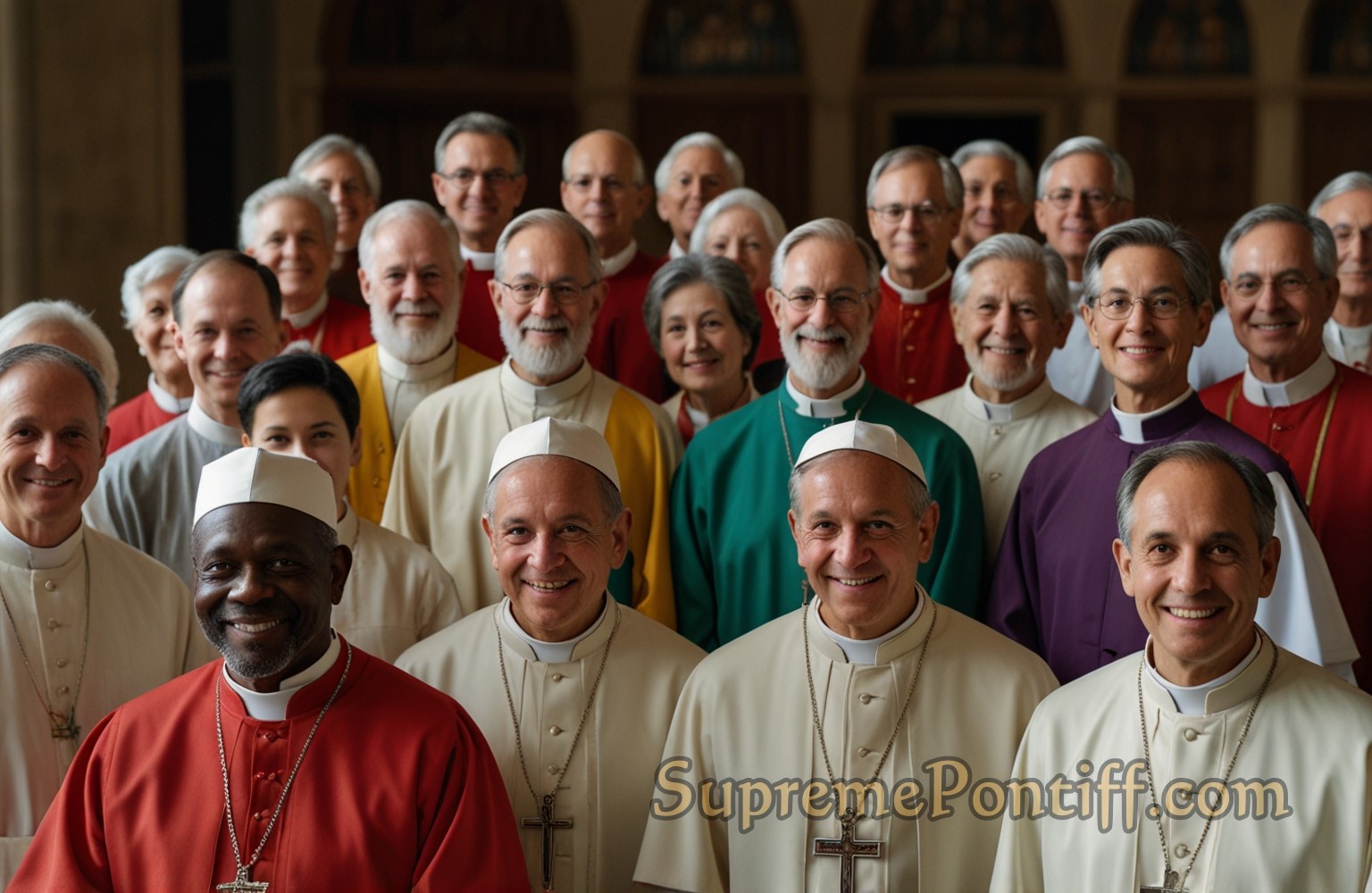
In a momentous event for Catholics worldwide, the Church now prepares for the Papal Conclave of May 7, 2025, following the passing of Pope Francis on April 21 and his funeral on April 26. This Conclave stands out not only as the largest in the Church’s history – with 133 cardinal-electors poised to enter the Sistine Chapel – but also as arguably the most geographically diverse. It promises to herald a new chapter for the Catholic Church, exemplifying the universal nature of the Gospel message and Pope Francis’ commitment to making the Church’s highest leadership more reflective of the global Catholic community.
A Universally Minded Pontificate
Pope Francis, during his twelve-year pontificate, continuously championed diversity in the College of Cardinals. By naming cardinals from 72 different nations, he symbolically wove the tapestry of the universal Church, ensuring that even Catholics in nations with small or historically underrepresented Catholic populations would have a place at the Church’s most important decision-making table. Countries like Pakistan, Iran, and Mongolia – once overlooked for the red hat – have since been brought into the fold.
This remarkable broadening extended to over two dozen countries that had never before had a cardinal, such as Haiti, Papua New Guinea, East Timor, Singapore, and South Sudan. As a result, the upcoming Papal Conclave truly embodies that universal calling of the Gospel: “Go into all the world and proclaim the Good News to all creation.”
The Global Spread of Cardinal-Electors
In 2013, when Pope Francis was elected, Italy maintained a dominant presence among the cardinal-electors. Today, while Italy still has the largest single delegation (17 voting members), the growth in representation from Africa, the Middle East, Asia and the Pacific, and Latin America has significantly reshaped the profile of the College of Cardinals. Latin America, with its centuries-old Catholic heritage, is no longer the only region experiencing fresh representation – places like Africa, Asia, and Oceania also have a noteworthy share of electors.
In some instances, these new cardinals hail from regions where Catholics remain a small minority. Consider Iran, whose Catholic population of 13,600 now has one voting cardinal – a ratio of 13,600 Catholics per elector – arguably more “representation,” on paper, than even Brazil, the country with the largest Catholic population in the world (105.3 million Catholics and seven cardinal electors, thereby 15,043,000 Catholics per elector). Of course, as the Catholic Church is not a representative democracy, these numbers serve more as an interesting illustration of the global makeup of the Church rather than a strict parallel to political representation.
Mongolia: A Symbol of Outsized Influence
An especially striking example is Mongolia, whose Catholic population amounts to just over a thousand faithful. Yet it will have a cardinal-elector in the 2025 Conclave. This unique situation means that Mongolia’s 1,116 Catholics effectively have one “voice” in the voting process – an extraordinary ratio that places the country as No. 1 in “proportional representation.” The presence of an Italian-born cardinal ministering in Mongolia underscores the truly universal character of the Church: it reaches across cultural, linguistic, and geographic boundaries, united in its love of Christ.
Looking to Brazil, Italy, Mexico and the USA
Among the largest Catholic populations where the Church has traditionally had a strong presence, Brazil, Italy, Mexico, and the United States stand out:
- Brazil: With more than 105 million Catholics, Brazil has seven cardinal-electors. While that is a high number in absolute terms, it spreads representation thinly at about 15 million Catholics for each voting member.
- Italy: Despite having 17 electors – the most of any single country – Italy’s large Catholic population places it in the middle tier for proportional representation. With approximately 2.47 million Catholics per voting cardinal, Italy ranks 33rd when measured by “Catholics per elector.”
- Mexico: Home to roughly 91.2 million Catholics but with only two participating cardinals, Mexico finds itself toward the bottom in terms of proportional representation, at 45.6 million Catholics per elector.
- The United States: With nearly 67 million Catholics in the country and 10 cardinal-electors, the ratio stands at around 6.7 million Catholics per elector (56th place in the rankings). Even so, the U.S. delegation remains the second-largest after Italy when counted in raw numbers alone.
On the other end of the spectrum are nations that have historically been pillars of Catholicism but will not cast votes in the upcoming Conclave. Among them is Ireland, whose Catholic heritage is woven deep into its cultural fabric – though it is worth noting that Cardinal Kevin Farrell, the camerlengo for this Conclave, is Irish-born but has ministered in the United States for most of his clerical life. Similarly, nations such as Vietnam, Lebanon, Mozambique, Mauritius, the Dominican Republic, and Honduras lack cardinal-electors for this Conclave, highlighting that some otherwise vibrant Catholic communities will not have direct participation in selecting the next Pope.
What This Diversity Means for the Universal Church
The Catholic Church’s beauty lies in her universality: “Catholic” itself means “universal.” This principle has guided the Church’s mission throughout the centuries, from St. Peter’s decision to baptize Gentiles to the modern emphasis on missionary activity. The 2025 Papal Conclave, with 133 cardinal-electors drawn from more nations than ever, signals the Church’s ongoing commitment to being a spiritual home for all peoples, regardless of cultural or national boundaries.
Undoubtedly, a larger and more diverse College of Cardinals offers fresh perspectives on issues ranging from evangelization to social justice, allowing the next Pope to draw upon a broader range of experiences in shepherding the faithful. It also provides an inspiring reminder of the truth that the Church, while deeply rooted in tradition, is alive and dynamic, ever striving to proclaim the Gospel anew in each generation.
Conclusion: On the Cusp of a New Era
As the faithful prepare for May 7, 2025, and the imminent election of Pope Francis’ successor, the Catholic Church stands both united in grief and hopeful for the future. This funeral on April 26 and the subsequent Conclave are historic milestones, solidifying Pope Francis’ legacy of inclusivity and worldwide outreach. Whether in countries with massive Catholic populations like Brazil, Italy, Mexico, and the U.S., or newly represented nations such as Mongolia and Iran, each cardinal-elector is called to listen to the prompting of the Holy Spirit for the good of the universal Church.
The heightened diversity and the record number of electors demonstrate the ever-growing global network of faithful who look to the Church for moral guidance, pastoral care, and the living witness of Jesus Christ. In this sense, the 2025 Papal Conclave resonates deep within the heart of Catholic identity: a Church truly gathered from every corner of the earth, set to choose a shepherd who will continue to lead, teach, and sanctify the flock in a spirit of unwavering love for all humanity.

Leave a Reply