On April 21, 2025, the hearts of the faithful were grieved when our beloved Holy Father, Pope Francis, passed into eternal life. This marked the end of a papacy dedicated to proclaiming the mercy of Christ, seeking justice and compassion for the marginalized, and fervently guiding the universal Church in truth and charity. His funeral was held in the solemn grandeur of St. Peter’s Basilica on April 26, 2025, with the eyes of the whole Christian world directed toward the Vatican. As dictated by long-standing tradition, the days immediately following a pope’s death are filled with rituals that both express the Church’s mourning and safeguard its integrity until the next Supreme Pontiff can be elected.
Among these traditions is a poignant and historically rich ceremony: the destruction, or nullification, of the Ring of the Fisherman. This ring has deep roots in the office of the pope and has long served as a powerful emblem of the Petrine ministry, evoking the commission given by Jesus to St. Peter — “the fisherman” — to shepherd His Church. Below is a comprehensive look at the Fisherman’s Ring, the lead seal, and their sacred significance within the Catholic faith.
1. Historical Roots and Symbolism of the Ring of the Fisherman
The Ring of the Fisherman, often known simply as the Fisherman’s Ring, takes its name from an image of St. Peter in his role as a fisherman. By placing a fisherman on the ring, the Church has, for centuries, symbolized the mission of the pope as a “fisher of men” (Mark 1:17).
- The first recorded instance of the ring’s use is found in the letters of Pope Clement IV (1265–1268). At that time, it was employed with a wax seal to authenticate private papal correspondence, thus setting it apart from the official lead seal that was used to seal more solemn documents and bulls.
- Around the mid-fifteenth century, the rendering of St. Peter with a fishing net became the standard design, cementing the ring’s popular name.
- Even after 1842, when the official use of the ring and wax seal was largely replaced by a stamp, each newly elected pope continued — and still continues — to receive his own unique Fisherman’s Ring at the start of his pontificate. This gives physical expression to the continuity of St. Peter’s office in the person of every pope.
2. The Death of a Pope and the Role of the Camerlengo
When a pope dies, the Church enters the period known as “sede vacante” (Latin for “the seat being vacant”). This transitional phase suspends certain ordinary mechanisms of governance until the next pope is elected during the Papal Conclave.
- The camerlengo, historically referred to as Cardinal Chamberlain, oversees the administrative affairs of the Holy See during this time. According to the apostolic constitution Universi Dominici Gregis, one of the critical responsibilities of the camerlengo is to seal the papal apartments, thereby preserving the sanctity and security of the dwelling place of the late Holy Father.
- Another essential task is the destruction of the Fisherman’s Ring and the lead seal used by the pope to authenticate papal documents. This symbolic act prevents any possibility of misusing the ring or seal to forge official communications.
3. The Finality of Destruction: Significance and Process
The breaking of the Fisherman’s Ring is a sober demonstration of the end of a pope’s reign and, at the same time, an affirmation that no one but the validly elected new pontiff has the authority to speak in the name of St. Peter.
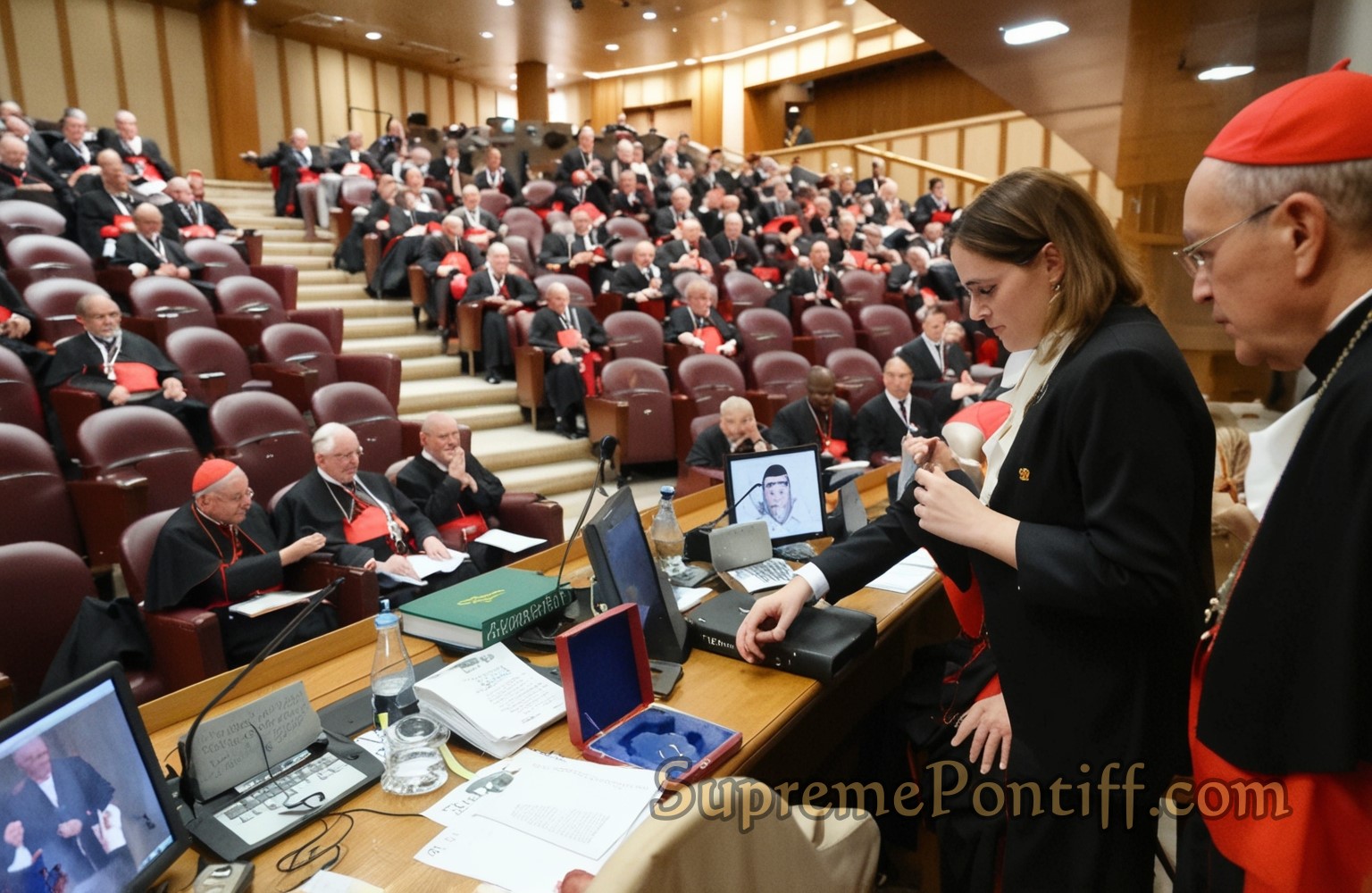
- On May 6, 2025, during the 12th general congregation of the College of Cardinals, Pope Francis’ Fisherman’s Ring and lead seal were duly destroyed in the presence of the Cardinals in the New Synod Hall. Cardinal Kevin Farrell, serving as camerlengo, supervised the procedure. Principal members of the College of Cardinals looked on to witness the ritual and ensure its proper completion.
- Although described as a “destruction” or “nullification,” the ring and seal may not be entirely obliterated in modern practice. Instead, they are defaced or broken sufficiently to render them unfit for further use. This ensures that no future documents could bear the mark or seal of the late pope.
4. Preparation for the Conclave and the Election of the Next Pope
After the passing of Pope Francis on April 21, 2025, and following his funeral on April 26, the College of Cardinals began to assemble from all corners of the globe to choose his successor.
- The date for the Papal Conclave was announced as May 7, 2025, signaling a time of deep prayer, reflection, and discernment for the cardinals entrusted with the sacred mission of electing the next Vicar of Christ.
- On May 6, 2025, only one day before the conclave, the destruction of Pope Francis’ Fisherman’s Ring reinforced the finality of his pontificate and cleared the way for the orderly selection of the next pope.
5. The Enduring Meaning of the Fisherman’s Ring in Catholic Life
From the very start of Church history, the papacy has been linked to St. Peter and his unique role among the Apostles. The Fisherman’s Ring, while not the only symbol of papal authority, profoundly proclaims the spiritual fatherhood of the Holy Father, his call to be the shepherd of souls, and the indispensable succession from St. Peter.
- This tradition underscores a humble yet powerful legacy: the pope, called to exemplify Christ’s love, must loyally cast his net to gather the faithful into the saving message of the Gospel.
- Even though Pope Francis characteristically favored a simpler style and often wore only his episcopal ring outside of formal papal ceremonies, the symbolic Fisherman’s Ring remained intimately linked to his office. Its nullification after his death highlights a deeply held belief that no one but the newly elected pope may speak or act in the name of Peter.
Conclusion
The destruction of the Fisherman’s Ring after the death of a pope is a poignant moment for all Catholics, embodying both grief and hope. In the passing of Pope Francis, the Church bids farewell to a modern-day fisher of men who upheld the unity of the faithful and extended Christ’s love to a world longing for peace and reconciliation. Yet even as the ring is broken, the blessing of continuity and communion resonates throughout the Church. On May 7, 2025, the cardinals will gather under the inspiration of the Holy Spirit to elect a worthy successor, someone who will don a new Fisherman’s Ring, carry forward the mission of Peter, and continue guiding the boat of the Church with unwavering devotion and love for Christ.
The ritual destruction of Pope Francis’ ring and seal remains deeply rooted in the Church’s time-honored tradition and safeguards the sanctity of the papal office. Far more than a ceremonial act, it honors the Church’s unwavering commitment to integrity before God and all humankind — ensuring that each shepherd, from Peter to the present day, may serve as a powerful witness to Christ’s boundless mercy and truth.



Leave a Reply